
By K.Siddhart
As a Senior Trial Attorney and Legal SEO Strategist, I navigate the ever-evolving landscape of personal injury law. The year 2026 ushers in significant legislative and judicial shifts across the United States, profoundly impacting how claims are valued, litigated, and ultimately resolved. From critical tort reform efforts in key states to the nuanced development of liability standards for autonomous vehicles, understanding these changes is paramount for legal professionals and individuals alike. This “Litigation Outlook” for April 9, 2026, delves into the most pressing developments, with a particular focus on how New Personal Injury Laws in the United States are reshaping the legal paradigm.
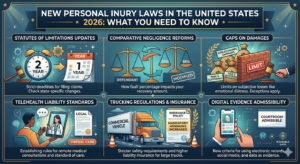

The Shifting Sands of Tort Reform: State-Specific Updates
Tort reform remains a contentious but active area of legislative focus, with several states proposing or enacting measures designed to rein in litigation costs and alter damage recovery mechanisms. While no sweeping federal New Personal Injury Laws in the United States were signed this month, April 2026 highlights ongoing state-level efforts that demand close attention.
Florida’s Legislative Tug-of-War
In Florida, the legal community is closely watching a series of bills introduced during the 2026 legislative session that aim to roll back significant portions of the state’s landmark 2023 tort reform law, House Bill 837. These proposed New Personal Injury Laws in the United States, if passed, could reintroduce attorney fee awards in specific insurance disputes (HB 1551/SB 426), permit plaintiffs to present evidence of medical expenses not limited to actual amounts paid (HB 947/SB 1520), and allow medical providers to recover attorney fees in Personal Injury Protection (PIP) cases (HB 1437/SB 1840). These discussions underscore a persistent tension between protecting insurance interests and ensuring adequate recovery for injured parties. A recent February 2026 report, however, suggests that the 2022 and 2023 tort reforms (Senate Bill 2-A and HB 837) have already had a positive impact on property and casualty insurance premiums, stabilizing costs and spurring economic growth. This ongoing legislative debate exemplifies the dynamic nature of New Personal Injury Laws in the United States.
Texas: Streamlining and Capping Damages
Texas continues its trajectory of refining its civil liability framework. While Senate Bill 30 (SB 30), aimed at limiting health care-related damages and curbing “nuclear verdicts,” saw significant movement in April 2025 by passing the Senate and being referred to the House, its full enactment status in April 2026 requires careful monitoring of legislative progress. Nevertheless, the “Definitive Guide to Texas Tort Reform and Civil Liability in 2026,” published in early April, emphasizes the immediate impact of Rule 166a Amendments, which are enforcing faster case resolution and greater judicial accountability. Furthermore, Texas maintains a robust proportionate responsibility framework that directly influences case valuation, settlement negotiations, and trial strategies. These provisions, effectively operating as New Personal Injury Laws in the United States, set statutory damage caps on non-economic damages in medical malpractice cases and limit punitive awards in general civil litigation, compelling litigators to front-load discovery and build definitive factual records well before summary judgment motions.New Personal Injury Laws in the United States 2026
California’s Push for Consumer and Business Balance
California’s approach to personal injury law in 2026 reflects a drive for both consumer protection and business stability. Senate Bill 84 (SB 84), a measure backed by tort-reform advocates, offers small businesses a 120-day grace period to rectify Americans with Disabilities Act (ADA) violations before lawsuits can be filed, a step designed to mitigate “predatory lawsuits.” Additionally, a significant “Establish Personal Injury Lawyer Regulations Initiative (2026)” is slated for the November 2026 ballot, proposing to mandate that car accident victims receive at least 75% of total damages, establish medical expense recovery standards tied to Medicare rates, and outlaw referral agreements between personal injury law firms and medical providers. Other legislative proposals for 2026 include Assembly Bill 2305, which seeks to prevent corporate influence in the practice of law, and Assembly Bill 2039, aimed at strengthening consumer protection and legal ethics. Moreover, the sunset provision for Senate Bill 447, which allowed for the recovery of pain and suffering damages for decedents, expired on January 1, 2026, unless further legislative action is taken, potentially reverting to prior restrictions. These ongoing legislative discussions represent crucial New Personal Injury Laws in the United States and reflect the state’s efforts to balance various stakeholder interests.
Autonomous Vehicles: Navigating Liability in an AI-Driven World
The proliferation of autonomous vehicles (AVs) continues to challenge existing legal frameworks, particularly concerning liability in accident scenarios. As of April 2026, the National Highway Traffic Safety Administration (NHTSA) is actively working to adapt regulations to this burgeoning technology, signaling a blend of policy modernization and aggressive enforcement. While no definitive, overarching liability framework has been established for AV accidents, NHTSA’s guidance focuses on ensuring safety and removing regulatory barriers to innovation.
In March 2026, NHTSA proposed amendments to Federal Motor Vehicle Safety Standards (FMVSS), intending to remove requirements for certain safety equipment deemed unnecessary in fully autonomous vehicles lacking human drivers. A separate proposal in late March 2026 specifically addressed FMVSS No. 110, regarding tire information placards, suggesting flexibility for AVs without a traditional “driver’s side.” These incremental changes highlight the agency’s strategy to allow AV deployment while still applying its broad defect authority for recalls to any system posing an “unreasonable risk to safety.” NHTSA monitors AV performance through crash reports and has launched defect investigations and overseen recalls when necessary. The proposed SELF DRIVE Act, currently under consideration, could further streamline these efforts by preventing FMVSS from mandating manual controls in ADS-dedicated vehicles.New Personal Injury Laws in the United States 2026
The absence of explicit federal New Personal Injury Laws in the United States defining AV liability means that existing tort principles, such as negligence, product liability, and potentially new theories of strict liability against manufacturers or operators, will likely govern these complex cases. The focus remains on the vehicle’s design, software, and operational parameters, and how these factors contribute to an accident. The evolution of New Personal Injury Laws in the United States in this domain will continue to be a critical watch point for trial attorneys.
The Echo of ‘Nuclear Verdicts’ in Trucking Accidents
The specter of “nuclear verdicts”—jury awards exceeding $10 million—continues to cast a long shadow over the trucking industry in April 2026. This sentiment is one of grave concern, as these massive awards are escalating, with some reaching “thermonuclear” levels over $100 million, and a reported 45% increase in such cases in 2024 alone. These verdicts are not random; they stem from catastrophic injuries, evidence of corporate culpability (e.g., systemic failures, negligent hiring), willful violations of Federal Motor Carrier Safety Administration (FMCSA) regulations (such as Hours-of-Service), and the presence of “smoking gun” evidence like falsified logbooks.
The financial ramifications are severe, driving up insurance premiums by as much as 12.5% and ( New Personal Injury Laws in the United States 2026 ) threatening the economic viability of smaller and mid-sized carriers, many of whom face bankruptcy after a single such verdict. The U.S. Chamber Institute for Legal Reform projects that commercial vehicle litigation could contribute a staggering 15% to food price inflation over the next decade. While the sentiment generally points to increasing awards, there are nascent signs of judicial scrutiny, with a Philadelphia judge in November 2025 significantly reducing a punitive damages award in a trucking accident case, offering a glimmer of hope for transportation companies. Nevertheless, the consensus among legal experts and industry stakeholders is that nuclear verdicts remain a pervasive and growing challenge for trucking companies, necessitating robust risk management and defense strategies. Addressing this challenge is a key part of the current discussion around New Personal Injury Laws in the United States.
Comparative Fault: A Paradigm Shift in Claims Valuation
One of the most impactful New Personal Injury Laws in the United States influencing the valuation of claims this year is the ongoing shift in comparative fault standards across various jurisdictions. Comparative fault, or comparative negligence, dictates how damages are apportioned when multiple parties share responsibility for an injury. Historically, states have operated under either “pure” or “modified” comparative negligence systems.
Under a “pure” comparative negligence system, a plaintiff can recover damages even if they are 99% at fault, with their recovery simply reduced by their percentage of fault. In contrast, “modified” comparative negligence typically bars recovery if a plaintiff’s fault exceeds a certain threshold (commonly 50% or 51%).New Personal Injury Laws in the United States 2026
Louisiana provides a prime example of this significant shift. Effective January 1, 2026, Louisiana transitioned from a pure comparative fault system to a modified comparative fault standard, specifically the “51% bar.” This means that any individual found to be 51% or more at fault for an accident is now completely barred from recovering damages. Those found 50% or less at fault can still recover, but their damages will be reduced proportionally to their share of fault. This is a profound change for a state that previously allowed recovery even for parties largely responsible for an incident, and it fundamentally alters the calculation of potential recovery for accident victims.New Personal Injury Laws in the United States 2026
Texas has long adhered to a modified comparative fault rule, often referred to as “proportionate responsibility.” Here, a plaintiff can recover damages as long as their percentage of responsibility does not exceed 50%. If a plaintiff is, for instance, 48% liable, they would be eligible to recover 52% of the total damages. This system encourages parties to consider shared fault diligently during settlement negotiations to avoid lengthy legal battles.
Florida also made significant changes to its comparative fault rules with HB 837 in 2023, shifting from a pure comparative negligence standard to a modified one, adopting a “51% bar” similar to Louisiana’s recent change. Furthermore, in premises liability cases involving third-party criminal acts, HB 837 mandates that juries consider the responsibility of all contributing parties, including the property owner, the injured person, and the criminal actor, creating a presumption against liability for the property owner in certain circumstances.
Impact on Insurance Adjusters and Claims Valuation
The shift from pure to modified comparative negligence significantly changes how insurance adjusters value claims. In jurisdictions adopting a 50% or 51% bar, adjusters now have a powerful tool to deny claims entirely or drastically reduce settlement offers if they can demonstrate the plaintiff bears a substantial percentage of fault. New Personal Injury Laws in the United States 2026: This creates a higher threshold for liability for plaintiffs and places a greater emphasis on evidence that minimizes the plaintiff’s contribution to the accident. For adjusters, the new focus is on:
- Early and Aggressive Liability Assessment: Adjusters are now incentivized to conduct thorough investigations into fault immediately, seeking evidence that might push a claimant over the fault threshold. This includes detailed accident reports, witness statements, dashcam footage, and expert analyses.New Personal Injury Laws in the United States 2026
- Reduced Settlement Floors: In states with pure comparative negligence, adjusters would still offer a settlement, even if small, to a heavily at-fault plaintiff. With modified systems, the “floor” for settlement offers drops to zero if the plaintiff’s fault exceeds the statutory bar.
- Increased Litigation Risk for Plaintiffs: Claimants in modified comparative negligence states face a greater “all-or-nothing” risk. If a jury finds them 51% or more at fault, they walk away with nothing. This increased risk can pressure plaintiffs to accept lower settlement offers.
- Heightened Importance of Expert Testimony: Expert witnesses, such as accident reconstructionists, become even more critical in disputes over fault percentages, as their testimony can sway a jury’s determination above or below the crucial 50% or 51% threshold.
These New Personal Injury Laws in the United States on comparative fault represent a significant boon for insurance companies seeking to limit payouts, and a considerable challenge for plaintiffs and their attorneys, who must now build even stronger cases to demonstrate minimal fault on the part of their clients. This fundamental shift requires attorneys to be more strategic and proactive in their liability arguments, directly impacting potential recoveries. For more insights on how these regulations might affect insurance choices, you might find valuable information on Best Car Insurance Companies in USA 2026: 5 Shattering Secrets to Slashing Premiums by 40%.
The 2026 Liability Matrix
Understanding the interplay of New Personal Injury Laws in the United States and emerging technologies is crucial. The following table provides a snapshot of current and anticipated liability considerations:
| Scenario | New Rule/Development | Who is Liable? |
|---|---|---|
| Auto Accident (Driver Negligence) | Shift to Modified Comparative Negligence (e.g., Louisiana, Florida) | At-fault driver, reduced by plaintiff’s fault percentage (if below statutory bar). Plaintiff recovers nothing if fault meets/exceeds bar. |
| Autonomous Vehicle Accident | NHTSA focusing on adapting FMVSS for AVs; SELF DRIVE Act proposed. | Manufacturer (product liability/defect), software provider, fleet operator, or a combination, based on specific system failure. Human driver if retaining control. (Still developing via New Personal Injury Laws in the United States) |
| Trucking Accident (Nuclear Verdicts) | Increased scrutiny on corporate culpability, FMCSA violations, punitive damages. | Trucking company (direct negligence, vicarious liability), driver (negligence), potentially maintenance providers. Emphasis on systemic failures. |
| Medical Malpractice (Texas) | Statutory caps on non-economic damages ($250k per provider, $750k total); limits on punitive damages. | Healthcare provider/institution. Damages subject to statutory caps and specific limits under New Personal Injury Laws in the United States. |
| Product Liability (General) | Ongoing common law principles; potential for new regulations regarding AI integration. | Manufacturer (design, manufacturing defect, failure to warn), distributor, retailer. Strict liability often applies. |
Looking Ahead: The Future of Personal Injury Litigation
The landscape of personal injury litigation in the United States is in constant flux, driven by legislative action, judicial interpretations, and technological advancements. The emphasis on tort reform in states like Florida, Texas, and California reflects a concerted effort by various stakeholders to redefine the parameters of liability and damage recovery. While these efforts often aim to reduce insurance costs and curb perceived litigation abuse, they invariably impact the ability of injured individuals to seek full and fair compensation. These discussions will shape the trajectory of New Personal Injury Laws in the United States.
The emergence of autonomous vehicles presents a novel frontier, necessitating continuous adaptation of legal principles. As NHTSA grapples with the regulatory challenges, trial attorneys must be prepared to litigate cases where the “driver” is an algorithm, demanding deep technical understanding alongside traditional legal acumen. The increasing prevalence and severity of nuclear verdicts in the trucking industry also underscore the need for both robust defense strategies by corporations and diligent advocacy by plaintiffs’ attorneys to uncover systemic negligence. This is an area where New Personal Injury Laws in the United States are still catching up with technology.New Personal Injury Laws in the United States 2026
The shift in comparative fault standards, particularly the move from pure to modified comparative negligence, fundamentally alters the strategic calculus for all parties in personal injury claims. Insurance adjusters will be more aggressive in leveraging fault percentages, while plaintiffs’ attorneys must meticulously build cases to clear the higher bar for recovery. Staying abreast of these developments, including new government regulations on the insurance industry, is critical for effective legal practice.New Personal Injury Laws in the United States 2026
The legal profession, through organizations like the American Bar Association (ABA), plays a vital role in monitoring these changes, advocating for justice, and educating its members on the implications of New Personal Injury Laws in the United States. As we move further into 2026, adaptability, foresight, and a comprehensive understanding of these evolving legal currents will be the hallmarks of successful personal injury practice.New Personal Injury Laws in the United States 2026
[Internal Link: New Government Regulations on Insurance Industry]
The information provided in this article is for informational purposes only and does not constitute legal advice. For specific legal guidance, consult with a qualified attorney.