
The landscape of employee benefits claims has dramatically shifted in 2026, presenting unprecedented challenges and opportunities for every ERISA claim denial lawyer. A pivotal moment arrived on April 6, 2026, with the enforcement of the Department of Labor’s (DOL) groundbreaking “Black Box” Mandate. This new regulation compels insurance carriers and plan administrators to reveal the proprietary AI logic underpinning their claim denial decisions, a move poised to revolutionize how beneficiaries challenge adverse determinations. Navigating this new frontier requires a sophisticated understanding of both ERISA law and the intricate workings of artificial intelligence. An effective ERISA claim denial lawyer now acts as much as a digital forensic expert as a legal advocate, deciphering complex algorithms to champion their clients’ rights.
The DOL’s “Black Box” Mandate: A New Era for ERISA Claims
The April 6, 2026, DOL “Black Box” Mandate marks a seismic shift in the power dynamic between claimants and insurers. For years, beneficiaries faced opaque denial letters, often citing vague “medical necessity” without transparent justification. This lack of visibility left many without a clear path to appeal, forcing them into costly and often futile battles. The mandate now requires insurers to disclose the specific data points, algorithmic weighting, and decision-making pathways employed by their AI systems when processing and denying claims. This radical transparency aims to level the playing field, providing claimants and their ERISA claim denial lawyers with the ammunition needed to effectively challenge automated rejections.
This mandate is not merely a procedural change; it represents a fundamental philosophical reorientation towards beneficiary protection under ERISA. It acknowledges the growing reliance on AI in healthcare administration and proactively addresses the inherent risks of algorithmic bias and error. The Department of Labor’s Employee Benefits Security Administration (EBSA) has emphasized that this rule is designed to ensure fair and accurate claim adjudication. For more information on EBSA’s initiatives, visit their official site.
Why Transparency Matters: Unpacking AI Denial Logic
Before the mandate, the core issue for an ERISA claim denial lawyer was the inability to peer into the “black box” of AI decision-making. Insurers often shielded their algorithms as trade secrets, making it nearly impossible to pinpoint specific errors or biases. The lack of transparency allowed for a system where complex claims could be rejected based on automated parameters that might not fully account for individual patient circumstances or nuanced medical advice. This often led to unjust outcomes, especially for claims involving chronic conditions or innovative treatments. Now, with mandated disclosure, an ERISA claim denial lawyer can scrutinize the very code that led to a denial, identifying vulnerabilities and systemic flaws.
Understanding the internal mechanics of these AI systems is paramount. It allows for a targeted appeal strategy, moving beyond generic arguments to specific challenges against the AI’s data inputs or logical progression. This paradigm shift empowers legal teams to dissect why a particular claim was flagged, whether due to an outdated dataset, an incorrect weighting of symptoms, or a misinterpretation of medical codes. The mandate enables a more informed and precise legal challenge, ultimately benefiting the claimant seeking fair treatment under their employee benefit plan.
The Rise of AI in Claims Processing: What an ERISA Claim Denial Lawyer Must Know
Artificial intelligence has become an indispensable tool for insurers seeking to streamline operations and reduce costs. From initial claim submission to final adjudication, AI algorithms analyze vast datasets, identify patterns, and flag anomalies with incredible speed. This efficiency, while beneficial for administrative overhead, introduces new complexities for beneficiaries and their legal representatives. The challenge for an ERISA claim denial lawyer is to understand not just the legal statutes, but also the technological underpinnings of these automated systems.
The integration of AI means that denials are often generated not by human review, but by code. This necessitates a different approach to appeals, focusing on the data integrity and logical framework of the AI itself. An adept ERISA claim denial lawyer must be prepared to engage with concepts such as machine learning models, predictive analytics, and data governance. This specialized knowledge is crucial for effectively challenging decisions made by non-human intelligence. Without it, even the most experienced legal counsel may struggle to dismantle an AI-generated denial.
The Denial Anatomy: Human vs. AI Logic
The distinction between human and AI review processes highlights critical areas where errors can occur. Understanding these differences is vital for any ERISA claim denial lawyer. Human reviewers bring context, empathy, and the ability to interpret subjective medical nuances. AI, while fast, operates strictly on predefined rules and data points, lacking the capacity for subjective judgment.
| Criteria | Human Reviewer | AI Algorithm |
|---|---|---|
| Medical Necessity Interpretation | Contextual, relies on medical expertise and patient history, capable of subjective judgment. | Rule-based, relies on coded criteria, statistical patterns, and predefined parameters; struggles with nuance. |
| Review Time | Typically 45 minutes to several hours, involves manual document review and clinical judgment. | Approximately 1.2 seconds, rapid processing of data points and automated decision-making. |
| Error Risk | Prone to human error, cognitive biases, and inconsistencies across reviewers. | Prone to algorithmic bias (based on training data), data input errors, and lack of contextual understanding. |
This table illustrates the stark contrasts. While AI offers speed, its potential for systematic errors based on flawed programming or biased training data is a significant concern for an ERISA claim denial lawyer. The mandate provides the tools to investigate these very points of potential failure. 
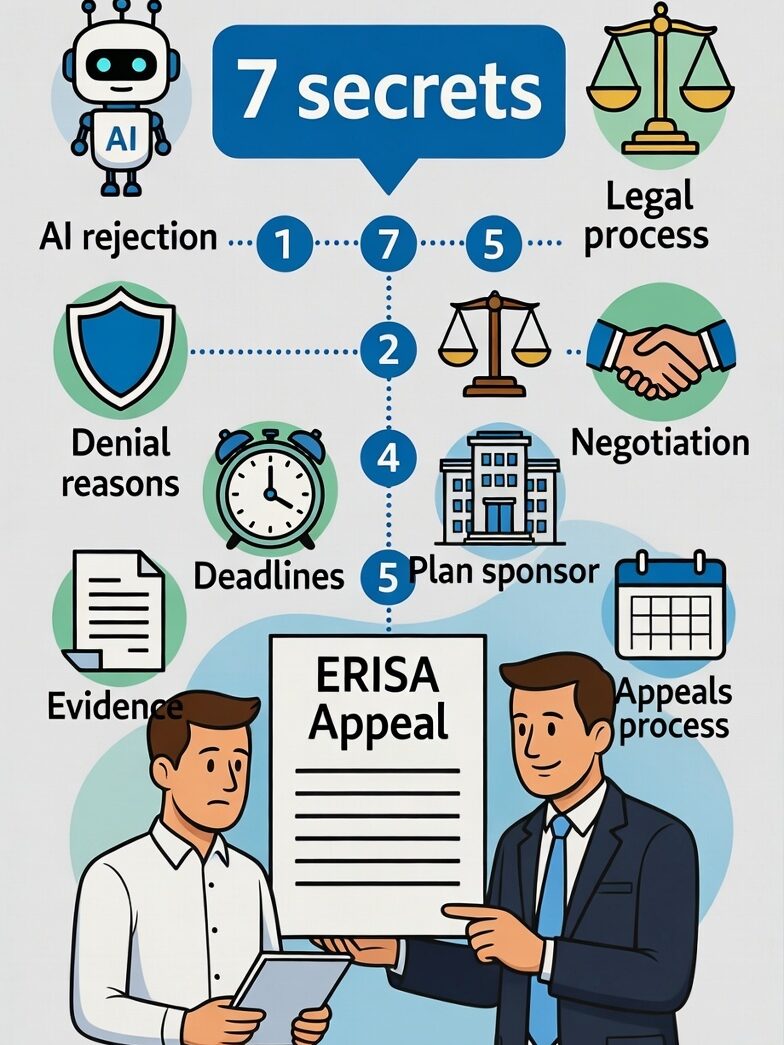
7 Shattering Secrets to Overcome Massive AI Rejections
To effectively combat AI-driven claim denials in the post-mandate era, an ERISA claim denial lawyer must adopt innovative strategies. These “secrets” leverage the new transparency requirements and evolving legal precedents to dismantle even the most complex algorithmic rejections. Success now hinges on a blend of legal acumen and a deep understanding of technological vulnerabilities. These approaches redefine what it means to be an effective ERISA claim denial lawyer in the digital age. They provide a framework for navigating the intricate interplay between technology and justice, turning the tables on automated denials.7 Shattering Secrets to Overcome Massive AI Rejections
- Secret 1: Proactive Data Collection and Pre-emptive Audits. Encourage clients to meticulously document all medical interactions, physician notes, and treatment rationales. With the “Black Box” Mandate, an ERISA claim denial lawyer can now request the specific AI parameters used for similar claims, allowing for pre-emptive audits of a client’s data against known denial triggers. This proactive approach helps identify potential issues before a claim is even submitted.
- Secret 2: Leveraging the Mandate for Discovery. The April 6, 2026, mandate provides unprecedented discovery power. An ERISA claim denial lawyer should immediately demand the full AI logic, including algorithms, training data sets, and any internal audit reports related to the AI’s performance and bias. This information is critical for uncovering errors that led to the denial.7 Shattering Secrets to Overcome Massive AI Rejections
- Secret 3: Expert Witness Integration (AI Auditors). The new era necessitates collaboration with AI auditors and data scientists. These experts can analyze the disclosed algorithms for flaws, biases, or inconsistencies in their application to a client’s specific case. Their testimony provides the technical foundation an ERISA claim denial lawyer needs to challenge the AI’s output in court.7 Shattering Secrets to Overcome Massive AI Rejections
- Secret 4: Challenging Algorithmic Bias. Many AI systems are trained on historical data, which can inadvertently perpetuate biases present in past human decisions. An ERISA claim denial lawyer can now directly challenge whether the AI’s training data disproportionately impacts certain demographic groups or medical conditions, leading to discriminatory denials. This focus on systemic bias can invalidate entire denial protocols.
- Secret 5: Strategic Appeals Process Focused on AI Deficiencies. Appeals should no longer be generic. They must specifically address the identified shortcomings of the AI system, citing precise data points or logical errors discovered in the disclosed algorithm. This precision forces the insurer to defend its AI, rather than simply reiterating a denial. This makes the work of an ERISA claim denial lawyer much more targeted.7 Shattering Secrets to Overcome Massive AI Rejections
- Secret 6: Class Action Potential for Systemic AI Failures. If an ERISA claim denial lawyer uncovers a pervasive flaw or bias in an insurer’s AI system that affects numerous claimants, there is significant potential for class-action lawsuits. Such actions can compel broad changes in algorithmic design and provide compensation for a larger group of wrongfully denied beneficiaries. These cases can set new precedents for AI governance.
- Secret 7: The Role of the ERISA Claim Denial Lawyer as a “Digital Forensics Expert.” The modern ERISA claim denial lawyer must evolve into a digital forensics expert, capable of understanding and interpreting complex technical documents. This includes proficiency in reading pseudo-code, understanding data architectures, and articulating algorithmic failures in legal terms. This specialized skill set is crucial for future litigation.
These strategies represent a forward-thinking approach to an evolving legal and technological landscape. They underscore the necessity for continuous learning and adaptation for every ERISA claim denial lawyer. [Internal Link: See our 2026 Insurance Guide here]
The “Whale” Angle: Institutional Investment Shifts to AI-Audit Law Firms
The legal landscape surrounding AI-driven claim denials has caught the attention of institutional investors, ushering in what many are calling the “Whale” angle. Following several recent court discovery rulings that favored claimants by compelling full disclosure of AI logic, a significant shift in capital allocation is occurring. Institutional investors, recognizing the immense financial and reputational risks insurers face from flawed AI systems, are increasingly directing their funds towards “AI-Audit” law firms. These specialized firms possess the technical expertise and legal acumen to not only challenge AI denials but also to conduct comprehensive forensic audits of insurer algorithms. This trend reflects a growing understanding that proactive compliance and robust legal defense against AI-generated errors are paramount.7 Shattering Secrets to Overcome Massive AI Rejections
The market is responding to the clear signal from the courts: transparency in AI is no longer optional. This has created a fertile ground for law firms that can effectively litigate against algorithmic malpractice. Pension funds, hedge funds, and private equity groups are viewing these “AI-Audit” law firms as attractive investment opportunities, anticipating lucrative returns from successful class actions and systemic legal challenges. The ability of an ERISA claim denial lawyer in these firms to dismantle AI “black boxes” is now a key differentiator, attracting both clients and capital. This financial backing provides these firms with the resources to pursue complex, high-stakes litigation, further accelerating the shift towards algorithmic accountability.
The Future Landscape for ERISA Claim Denial Lawyers
The year 2026 marks a turning point for ERISA claim denial lawyers. The DOL’s “Black Box” Mandate, coupled with the rising tide of AI in healthcare, demands a new breed of legal professional. Success will hinge on a lawyer’s ability to bridge the gap between traditional legal principles and cutting-edge technology. This means ongoing education in data science, machine learning ethics, and the regulatory frameworks governing AI. The role of the ERISA claim denial lawyer is expanding, requiring expertise that transcends conventional legal practice.7 Shattering Secrets to Overcome Massive AI Rejections
The future will see more collaboration between legal teams and tech specialists, forming multidisciplinary units capable of dissecting complex algorithms. The focus will shift from simply arguing against a denial to meticulously proving how an AI system failed. This evolution ensures that even as technology advances, the fundamental principles of fairness and justice enshrined in ERISA continue to protect beneficiaries. The adaptive ERISA claim denial lawyer will be at the forefront of this critical legal and technological evolution, safeguarding the rights of millions in an increasingly automated world.
The emergence of the April 6, 2026, DOL “Black Box” Mandate has irrevocably altered the terrain for ERISA claims. For beneficiaries and their ERISA claim denial lawyers, this new transparency offers a powerful weapon against unjust AI rejections. The secrets outlined here – from leveraging discovery to embracing AI auditing – provide a roadmap for navigating this complex future. As institutional investors pivot towards firms adept at AI forensics, the message is clear: algorithmic accountability is here to stay. The effective ERISA claim denial lawyer will be the one who not only understands the law but can also master the nuances of the machines now making critical health and financial decisions.7 Shattering Secrets to Overcome Massive AI Rejections